
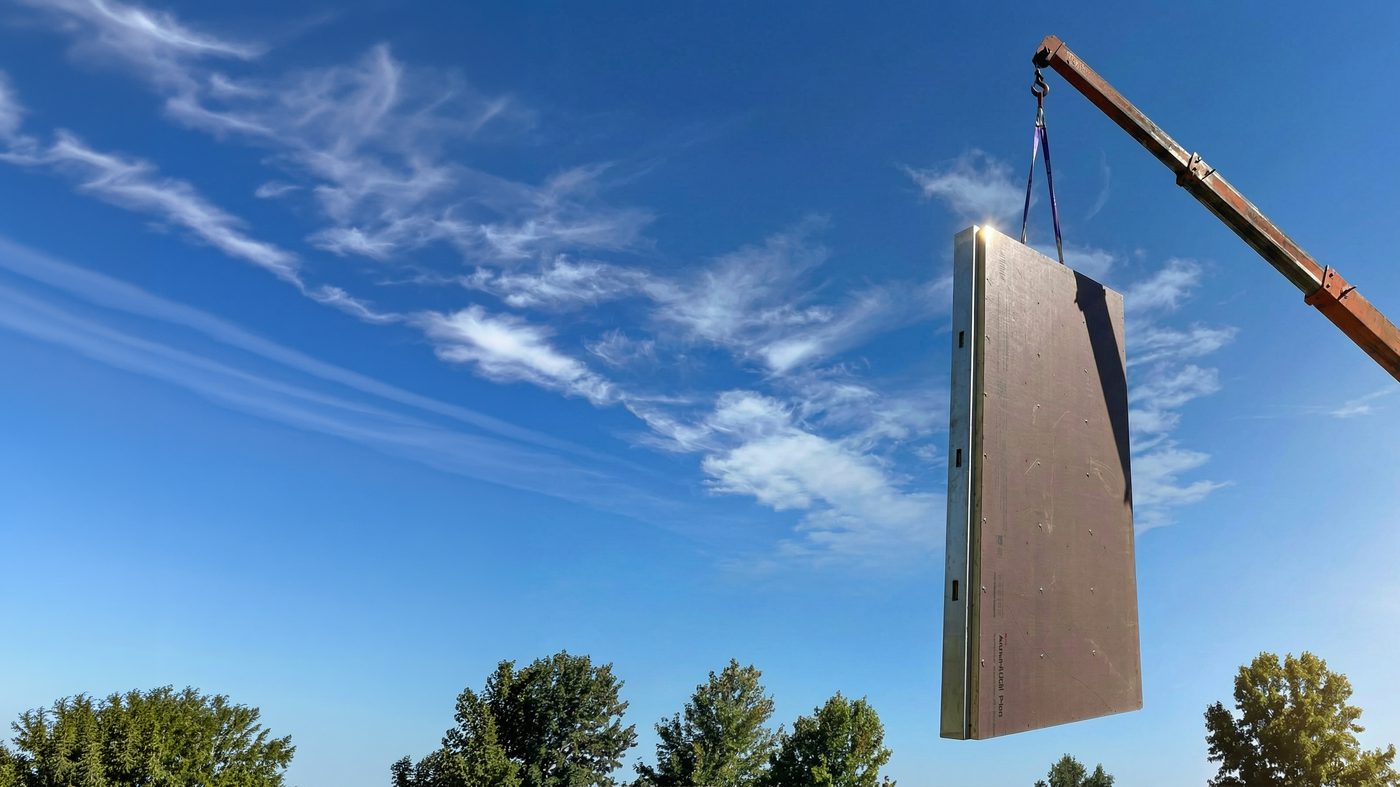
From Our Factory Floor · Hayward, CA
The shortest supply chain in California doesn’t leave the Bay Area.
Every 4C panel is engineered and assembled at our facility at 2447 Industrial Parkway in Hayward, right in the heart of the East Bay. For most California markets, that means a truck trip of several hours or more before a panel reaches the site. For Bay Area projects, from Oakland and Fremont to San Jose, San Francisco, and the North Bay, it can mean a same-day run from our production floor to your jobsite.
That proximity isn’t just shorter freight, it’s shorter lead times and in-person support from the same team that built the panel, without the quality risk of a system engineered somewhere else and shipped in.
Every panel leaving our Hayward floor, 4C SAFE™ and 4C ECO™ alike, is ICC-ES listed and patent pending, built to the same certified specification whether it travels two miles or two hundred.
The shortest supply chain in California is the one that doesn't leave the Bay Area.
Every 4C panel is engineered and assembled at our facility at 2447 Industrial Parkway, Hayward, CA 94545. For most other California markets, that means a truck trip of several hours or more. For Bay Area projects, it can mean a same-day run from our production floor to your site. See our full California coverage map to compare freight distance from Hayward to other regions we serve.
Shorter hauls, tighter schedules
Panels don't have to travel far to reach a Bay Area site, which simplifies delivery scheduling and reduces the freight cost built into your project budget.
Easy site visits, in both directions
Our team can walk your jobsite without a long drive, and you're welcome to visit the Hayward facility to see your panels in production before they ship.
Faster turnaround for local teams
Proximity to the factory means fewer logistics variables between design sign-off and panels arriving on site, a real advantage for architects and builders working on tight schedules.
Built for the Bay Area's cost pressure and density.
The Bay Area's construction costs are among the highest in the country, and much of the region's new housing and commercial work is infill: tight urban and suburban lots where efficient use of labor and schedule matters as much as the design itself. Keeping cost, carbon, complexity, and compliance in balance on projects like these is exactly what drives our mission as a manufacturer.
4C ECO™
Wood-framed, Type V panels built for budget-disciplined infill and multifamily work.
- Frame materialWood
- Best forMultifamily, ADUs, infill
- Cost profileBetter budget control
- ListingICC-ES ESR-3373
4C SAFE™
Steel-framed, fire-resistant panels for wildfire-exposed hillside terrain.
- Frame materialSteel
- Fire rating1-HR & 2-HR, fire-resistant
- Best forHillside & WUI sites
- ListingICC-ES ESL-1695 · Patent Pending
The East Bay and North Bay hills, along with other wildland-adjacent communities around the region, carry well-documented wildfire exposure. If your Bay Area site sits in or near that kind of terrain, 4C SAFE™ is worth evaluating alongside 4C ECO™. Talk to our team about which system fits your parcel.
Bay Area construction: the case for building in a factory, close to home.
A closer look at the cost, labor, and land pressures shaping construction across the Bay Area, and why a manufactured, panelized approach, made right here in Hayward, changes the equation for architects, developers, and builders.
The Bay Area is the hardest place in the country to build housing, and 4C's home market. Our facility at 2447 Industrial Parkway in Hayward sits in the middle of a region that needs an enormous amount of new housing and struggles to deliver it under conventional methods. Under the current Regional Housing Needs Allocation (RHNA), the nine-county Bay Area is expected to plan for roughly 441,000 new homes between 2023 and 2031, a pace of about 55,000 units a year. Actual production is running far below that: San Francisco had permitted only a small fraction of its eight-year target by the end of 2025, and San Jose's largest homebuilders together closed on the order of 1,000 homes in a year against an allocation of more than 62,000. The gap between what the region plans for and what it builds is where a faster construction method matters most.
The most expensive construction market in the country
Cost is the first wall every Bay Area project runs into. New residential construction here is routinely estimated in the range of $400 to $800 per square foot and higher, several times the national average, and San Francisco regularly ranks among the most expensive cities in the world to build in, driven by land, seismic requirements, Title 24 energy standards, and labor. Affordable multifamily development in California now often exceeds $400,000 to $500,000 per unit, with Bay Area metros at the top of that range. When each unit costs that much to deliver, shaving time and labor off the build is not a marginal saving, it's the difference between a project penciling out and stalling.
Manufacturing the building is one of the few levers that moves that number. A March 2026 study from UC Berkeley's Terner Center found that off-site and factory-built methods can cut construction time by 20 to 30% and total development costs by 5 to 20%, and California lawmakers have increasingly pointed to factory-built housing as central to the state's supply strategy. That is exactly what 4C does: we manufacture wall, floor, and roof components to exact specification at our Hayward facility, then deliver them pre-labeled and sequenced so the jobsite becomes an assembly operation rather than a fabrication one. Our construction manufacturing page explains how that process works end to end.
A shrinking, aging trades workforce
The second wall is labor. Roughly two-thirds of California contractors report skilled-worker shortages as their top constraint, and the trades most in demand, framers, electricians, plumbers, HVAC, are the same ones every Bay Area project competes for at once. Prefabrication directly relieves that pressure: by moving the bulk of assembly into a controlled plant staffed by a consistent crew, panelized construction has been shown to reduce on-site labor requirements by 15 to 20%. For a Bay Area GC trying to staff a project in a tight market, that means fewer trades to sequence on a cramped site and a schedule far less exposed to who is available on a given week. We work through those builders and general contractors and developers directly, rather than around them.
Infill and ADUs on land that barely exists
Buildable land is scarce across the Bay Area, so much of the region's new housing is infill: ADUs, backyard cottages, and small multifamily projects on tight urban and suburban lots. California has become the national center of ADU construction, now accounting for close to a third of all US ADU permits, and the Bay Area's own ADU volume has more than doubled since 2020. This is the work 4C ECO™ is built for: wood-framed, Type V panels (ICC-ES ESR-3373) engineered for thermal efficiency and budget control. Because panels install without heavy equipment or a large staging yard, they suit exactly the constrained lots and narrow setbacks that define Bay Area infill, and because 4C integrates with conventional design, financing, and permitting, an architect doesn't have to redesign an approved plan to use the system. For architects and designers, the configurator adapts existing drawings into manufacturable components rather than forcing a fresh start.
Wildfire exposure in the East Bay and North Bay hills
Not all of the region is flat urban infill. More than a million Bay Area homes now sit in the wildland-urban interface, and in several North Bay counties the large majority of housing falls within it. California's updated 2025 WUI building standards require ember-resistant materials and stricter assemblies for construction in those zones. For hillside and wildland-adjacent sites in the East Bay and North Bay, 4C SAFE™ offers a steel-framed, fire-resistant panel system rated 1-HR and 2-HR fire-resistive and WUI compliant (ICC-ES ESL-1695, patent pending), the same system behind our completed fire rebuilds in Altadena. It lets builders meet a higher resilience standard without giving up the speed of the panelized process.
The shortest supply chain in California
What makes the Bay Area distinct among the markets we serve is proximity. For most California projects, a panel travels several hours from our Hayward floor to the site. For a Bay Area project, it can be a same-day run. Shorter hauls mean lower freight cost baked into the budget, simpler delivery scheduling, and the practical ability for our team to walk your jobsite, or for you to visit the factory and see your panels in production, without a long drive. Fewer truck miles also lowers the transportation footprint we track as part of our sustainability commitments. It is, quite literally, the shortest supply chain we offer anywhere in the state.
How 4C works with the Bay Area construction industry
4C sells through the industry, not around it. We work exclusively through partners, architects, general contractors, developers, and material vendors, rather than direct to homeowners, so a manufactured panel system slots into the project teams already delivering Bay Area housing. In a region where cost and labor are the binding constraints and buildable land is fixed, moving more of the build into a nearby factory is one of the few strategies that adds real capacity without adding risk. That is the case for building here, close to where the panels are made. See how the two systems compare on our systems overview, or review completed work in our project portfolio.
A straightforward path from your plans to a delivered panel system.
We haven't published a completed Bay Area project yet. We're a young company and this is our home market, so we're building our local track record deliberately rather than rushing it. In the meantime, our project portfolio shows completed work in Los Angeles and San Diego County that reflects the same process you'd go through here. Here's what working with us actually looks like.
-
Share your plans
Send us your architectural drawings as they stand. No redesign is required: our engineering team reviews your existing plans for panelization.
-
System selection
We help you choose between 4C SAFE™ and 4C ECO™ based on your site conditions, budget, and construction type. Your architect or GC leads this step since we work through partners, not directly with homeowners.
-
Factory engineering & fabrication
Panels are engineered and manufactured at our Hayward facility, pre-labeled and sequenced for assembly.
-
Short-haul delivery
Because your site is likely within the greater Bay Area, delivery scheduling is simpler and freight costs are lower than for our more distant markets, which also reduces the transportation footprint we track as part of our sustainability commitments.
-
Onsite assembly support
Panels arrive ready to assemble with no heavy equipment required, and our team is a short drive away if your crew needs support.
Building in the Bay Area? Start where the panels are made.
Talk to our Hayward-based team about specifying 4C SAFE™ or 4C ECO™ on your next Bay Area project.